Lab life: 365 days moving between the white of labcoats and the red of blood – a master student’s experience
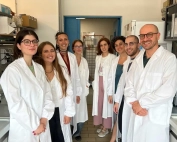
Three, two, one… Let’s go! We are Gianluca and Arianna, and we will tell a story about our recent research internship in the HEVA Research Lab. What a fantastic experience!
Greeted by our prof. Emanuele Azzoni, we soon noticed smiles on the faces of our older colleagues who were close to graduating.
What was ahead of us? Would have we been so happy at the end of our journey? Well, we just had to find out!
The first impression we had was that we were in a place that was very dynamic and full of stimuli. Moreover, the positivity and the kindness of our coordinators was the optimal background to face this experience in the best way and to work productively and peacefully.
We immediately began to familiarize with the key word of our laboratory: Blood.
During our internship, we had the opportunity to experience working with in vivo models. Beyond blood sampling, bone marrow extraction and fetal liver transplantations, we got to grip with the most common analysis techniques of our lab, for example: flow cytometry analysis, blood counts, but also whole-mount immunostainings, cell cultures, Western blots, sequencing, PCR and so on.
Specifically, we took part in two very interesting and stimulating projects that became the main topics of our thesis.
So, now we are going to tell you something about our thesis projects…
Project 1:
Who are the main actors in embryonic hematopoiesis?
Half past nine in the morning, we are getting ready to enter the animal facility to take blood samples from mice. Today we have planned to perform the regular FACS analysis on transgenic lineage tracing mice that we use for our ultimate aim of better understanding embryonic and fetal hematopoiesis.
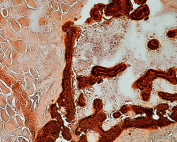
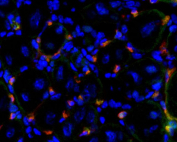
In fact, embryonic hematopoiesis is a complex system, organized in at least 3 different waves that overlap in space and time. Thanks to a variety of techniques, such as FACS analysis, Whole Mount Immunostaining and Single Cell RNA sequencing, we tried to delve deeper into understanding this process in more detail.
The model we used is based on the expression of the Cre recombinase, fused with ERT2 a domain of the estrogen receptor, under the control of Cdh5 promoter. These mice are crossed with other mice that carry the reporter gene inside the R26 locus and this gene is flanked by lox STOP lox sequences. Through intraperitoneal administration of 4-hydroxytamoxifen (4-OHT) we are able to control the activity of the Cre and therefore the expression of the reporter gene. Thanks to this system we are able to label cells of interest because once the expression of the reporter gene is activated, its expression is kept in the cellular progeny.
Moreover, recently has been found out that Hematopoietic Stem Cells (HSCs) have a limited role in fetal hematopoiesis, so we tried to answer some questions such as:
- Which are the progenitors that support the fetal hematopoiesis?
- Where they originate?
- When they emerge?
During this last year of internship we have worked in a team to try to answer these questions. More specifically, we have discovered that there is a group of progenitors that emerge starting from E8.5 in the vitelline and umbilical arteries, that appears to support embryonic hematopoiesis and their contribution seems to decrease in the adult. These data and works will soon be published in a research article.
Studying normal hematopoiesis is important to improve our knowledge in this field, but also because, if we know how this system normally works, we can better understand how diseases arise and therefore identify potential therapeutic strategies. For example, in this case, we can better clarify which are the main hematopoietic progenitors susceptible to mutations that lead to the development of pediatric forms of leukemia.
Project 2:
Could the heterogeneity of jmml be linked to heterogeneity in the cell of origin?
Juvenile Myelomonocytic Leukemia (JMML) is a rare hematological pediatric cancer, that occurs in children under 3 years of age. Clinical features are highly heterogeneous and include uncontrolled proliferation of myeloid cells, monocytosis, granulocytosis, anemia, hepatosplenomegaly.
Today, no resolutive treatments are available, with the exception of bone marrow transplantation, which fails to cure 50% of patients, mainly due to disease relapse.
Experimental evidence suggests that the disease originates prenatally, therefore during the embryonic phase. Moreover, the heterogeneity of JMML suggests the hypothesis of variability in the cell of origin, which could consequently determine a different course of the disease.
To verify this hypothesis, we selectively induced the KrasG12D mutation (one of the most frequent genetic lesions found in this leukemia), in the possible cells of origin, using a transgenic mouse model of JMML. To do this, the inducible Cre-LoxP system was used, which is activated following administration of 4-OHT just as explained above.
What we noticed was that the disease occurred in mice both when the mutation was activated in HSCs and also when it was activated in HSC-independent progenitors. In the first case, however, the mice showed a more aggressive myeloproliferative phenotype, whereas in the second case it was less aggressive as the penetrance of the disease was incomplete and the latency was longer.
Despite our progress, in order to gain a better understanding of the molecular mechanisms underlying our findings, further studies are still necessary.These include analyses based on next-generation sequencing techniques, such as ATAC-Seq, scRNA-Seq, MeDIP-Seq.
This taught us an important lesson on how research works: important discoveries are made in small steps.
Having contributed to obtaining these results makes us happy and proud of the path we have undertaken, hoping that our small discoveries could lead to great achievements in the future!
What did this experience give us?
“I’m happy to report and testify that the dynamism, the variety of techniques used, the many experiments we took part in, together with the availability, the kindness and the skills of our lab members, contributed to making this experience unique and educational, both from human and professional points of view.
Furthermore, the opportunity to perform in vivo work was the cherry on top, that made everything more interesting and stimulating. Following the progress and the various phases of the leukemia in the animals, day after day, allowed us to have a more complete vision of the disease and to get a better understanding of the disease itself.
I will always be grateful for the wonderful opportunity given to me and for having had the chance to expand my knowledge and experience in the fascinating and complex world of hemato-oncology”

Arianna Colonna
“I think that this experience was very important to me. It was very formative and useful to enrich my knowledge in such an important field of research. I am glad for having played a part in the ongoing projects and for having helped place a small brick that can help to achieve the ultimate goals.
I also think that one of the most interesting things of this opportunity is that I had the possibility to learn and experience recently developed techniques, such as Single Cell RNA sequencing. Moreover, this experience taught me how to work in a team and how to organize and schedule the different experiments to reach a certain goal.
I will always be grateful to HEVA Research Lab for the opportunity given to me, as this experience helped me growing as a person and as a scientist”

Gianluca Sala